

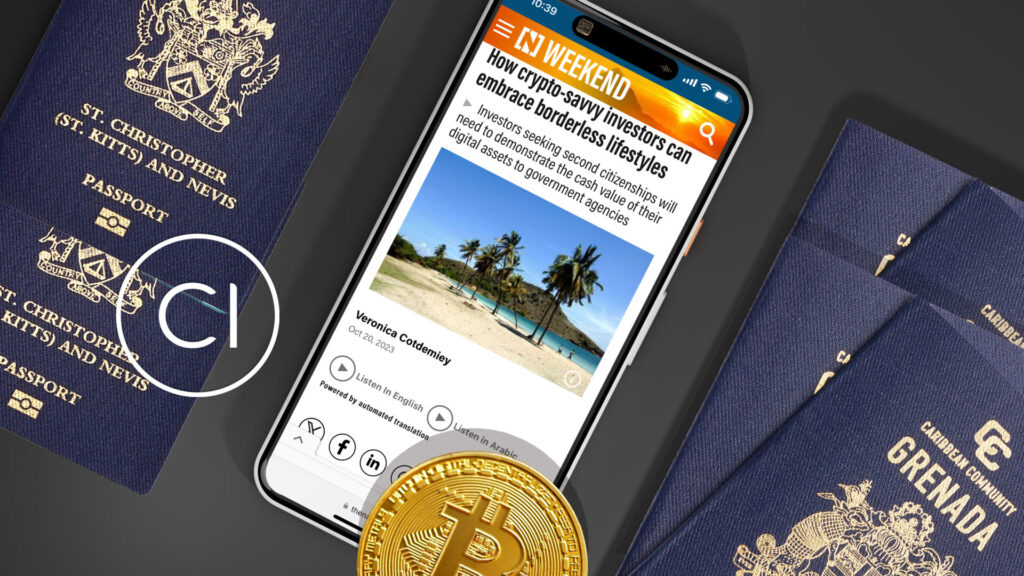
Crypto citizenship by investment can be possible when digital wealth is lawful, fully documented, converted through an acceptable provider, and transferred through a banking route that the selected program can verify.
However, holding enough Bitcoin, Ethereum, stablecoins, or other digital assets to meet an investment threshold does not make those funds automatically application-ready. The applicant must still prove ownership, explain how the wealth was created, document the exact source of funds, and complete the qualifying investment required by law.
This is why crypto citizenship by investment should not be marketed as a separate “crypto passport.” It remains a government-regulated citizenship or residence application involving wealth that originated partly or entirely from digital assets.
Quick Answer
Crypto citizenship by investment usually does not mean paying a government directly from a wallet. In most cases, the investor documents the digital wealth, converts the required amount into an accepted fiat currency, receives the proceeds through a bank account, and then completes the official contribution, property purchase, fund subscription, deposit, or other qualifying investment.
The process normally has two separate stages. The first is proving that the cryptocurrency is legitimate wealth belonging to the applicant. The second is moving the required amount through an acceptable financial route so the legally prescribed investment can be completed.
A private adviser, exchange, escrow provider, developer, or property seller may agree to receive cryptocurrency commercially. That does not prove that the government program itself accepts direct payment in Bitcoin, Ethereum, or stablecoins.
A credible crypto citizenship by investment file must connect blockchain history to identifiable people, lawful activity, regulated conversion, banking, and the final qualifying payment.
Investment migration can lead either to direct citizenship or to residence. These outcomes should not be combined when evaluating crypto citizenship by investment.
Citizenship by Investment programs grant nationality after the applicant passes due diligence and completes a qualifying contribution or investment. Depending on the country, the route may involve a government fund, approved real estate, a prescribed financial asset, or another legally defined option.
The investment does not become valid merely because its value came from cryptocurrency. The applicant must still follow the program’s authorised application, payment, and investment process.
Residency by Investment and Golden Visa programs grant residence rights rather than immediate citizenship. They may require property, regulated investment funds, business capital, deposits, or other qualifying assets.
Crypto may form part of the applicant’s wider wealth, but the digital asset itself is normally not the Golden Visa investment. The investor usually needs to convert the relevant amount and complete the specific investment named in the law.
Regional comparisons remain useful, but every crypto citizenship by investment case must separate official policy from private conversion services.
The Caribbean remains the most established region for direct Citizenship by Investment. St Kitts and Nevis, Dominica, Grenada, Antigua and Barbuda, and St Lucia operate regulated programs, but their published treatment of cryptocurrency is not identical.
The St Kitts and Nevis Citizenship Unit provides one of the clearest official positions. Its guidance states that cryptocurrency may be accepted as a partial source of wealth. It also requires separate proof of wealth that is not derived from cryptocurrency and applies additional due diligence requirements.
This does not mean that St Kitts and Nevis accepts direct government payment in cryptocurrency. It means that digital assets can form part of the applicant’s documented wealth within a wider application. For this reason, St Kitts and Nevis is a clearer example of a defined crypto citizenship by investment policy than programs that publish no specific digital-asset guidance.
Dominica illustrates the difference between source of wealth and payment method. The official Economic Diversification Fund instructions require the contribution to be paid by bank transfer in accepted fiat currencies. A crypto investor may therefore need to document and convert the assets before the final payment is made.
Antigua and Barbuda, Grenada, and St Lucia should not be presented with a blanket promise of direct crypto acceptance. A case may still proceed when the converted funds, source-of-wealth evidence, receiving bank, and authorised agent satisfy current requirements, but that is not the same as an official cryptocurrency payment route.
Turkey offers citizenship through prescribed investments, including real estate worth at least USD 400,000 and several financial routes starting from USD 500,000, subject to the applicable holding periods and authority confirmations.
For a Turkish crypto citizenship by investment case, cryptocurrency does not replace the required property, deposit, fund, bond, or capital investment. The more realistic structure is documented conversion, banking, and completion of the official investment in the accepted currency and legal form. The current thresholds are published by the Investment Office of the Presidency of Türkiye.
Vanuatu is often described online as crypto-friendly because private agents and settlement providers have advertised cryptocurrency services. That marketing should not be confused with the legal investment route. A Vanuatu crypto citizenship by investment application must still complete the prescribed contribution and satisfy the program’s due diligence and payment requirements.
Nauru’s Economic and Climate Resilience Citizenship Program offers citizenship through a contribution to the national Treasury Fund. The official program website currently publishes its contribution and fee structure, but it does not establish a blanket right to pay the government directly in cryptocurrency.
A Nauru crypto citizenship by investment case should therefore confirm the accepted source-of-funds evidence, conversion provider, receiving bank, and final payment route before any assets are moved. The official program details are available through the Nauru Program Office.
African investment migration routes are attracting more attention, but published government crypto policies remain limited. Newer programs should not be called crypto-friendly merely because private escrow or conversion services are available. Each file still requires verification of the legal program, authorised agent, receiving institution, and payment instructions.
Golden Visa and permanent residence programs can be relevant to digital-asset investors, but they are not the same as crypto citizenship by investment. The qualifying residence investment must remain the centre of the analysis.
Portugal’s current residence-by-investment framework includes a capital transfer of at least EUR 500,000 into qualifying non-real-estate collective investment undertakings established under Portuguese law. Cryptocurrency is not the qualifying fund investment.
A crypto investor may be able to use converted proceeds if the exchange, bank, fund, applicant, and source-of-funds file all satisfy the required checks. The official ARI routes are published by AIMA.
Greece and Cyprus offer residence routes linked to qualifying property or other prescribed investments. A property seller or intermediary may be commercially willing to receive cryptocurrency, but the immigration file, property registration, banking records, and investment evidence must still meet the official residence rules.
In these cases, crypto citizenship by investment is not the correct immediate description because the legal result is residence rather than direct citizenship. The relevant question is whether documented crypto-derived funds can be converted and used for the required residence investment.
Malta’s Permanent Residence Programme publishes a clear position on the capital requirement. The MPRP FAQ states that cryptocurrencies are not permissible as financial assets for that requirement. It refers instead to liquid assets such as stocks, bonds, publicly traded shares, funds, and bank deposits.
This does not automatically exclude every applicant who earned wealth from cryptocurrency. It means the applicant must satisfy the program’s financial and payment requirements using assets and evidence that the program accepts.
The phrase crypto-friendly often combines four separate questions. A responsible crypto citizenship by investment assessment must answer each one.
This explains how the applicant created their overall net worth. The evidence may begin with employment, business income, a company sale, investments, mining, staking, token compensation, or another lawful activity.
This follows the exact amount used for the application. It should connect the relevant wallet or exchange balance to conversion, bank receipt, and final qualifying payment without unexplained gaps.
This establishes how the money reaches the government fund, developer, investment fund, bank, or other approved recipient. Private crypto acceptance does not prove that the official program accepts the same route.
This is the contribution or asset required by law. Cryptocurrency does not replace the government fund, approved real estate, regulated fund, bank deposit, or other prescribed investment.
A defensible crypto citizenship by investment file should allow an independent reviewer to understand the complete economic history without guessing.
A wallet screenshot is not enough. It may show a balance, but it does not prove lawful origin, beneficial ownership, tax consistency, or the complete payment route.
A crypto citizenship by investment application does not usually become difficult simply because the investor owns digital assets. It becomes difficult when the financial history cannot be reconstructed clearly.
The outcome depends on the program, jurisdictions, counterparties, evidence, and applicant profile. The main mistake is discovering a weakness after the assets have moved.
The safest crypto citizenship by investment route normally separates the cryptocurrency stage from the official investment stage while maintaining one continuous audit trail.
This process does not remove due diligence or guarantee approval. It reduces avoidable uncertainty.
Liquidating digital assets can create tax, reporting, banking, and market consequences before the immigration application is submitted.
A disposal may trigger capital gains, income, corporate, or reporting obligations depending on the applicant’s tax residence, nationality, ownership structure, and transaction history. A new residence permit or second citizenship does not retrospectively change those obligations.
Timing also matters. Selling too early may leave the investor holding fiat while program selection remains unresolved. Selling too late may create pressure when documentation, banking, or payment deadlines arise.
A responsible crypto citizenship by investment plan therefore considers three timelines together: the tax event, the investment migration process, and the market risk of conversion.
For a clearer explanation of residence, taxation, holding periods, and payment stages, review Citizenship Invest’s investment migration FAQ.
The best crypto citizenship by investment program is not automatically the country most frequently described as crypto-friendly.
Investors comparing citizenship routes can review Citizenship Invest’s guide to the best citizenship by investment country. Those seeking residence should compare the available residency by investment programs separately.
Crypto citizenship by investment is reshaping investment migration, but not because governments have replaced regulated investments with direct wallet transfers.
Its real impact is that citizenship and residence programs must now assess a newer form of wealth through established source-of-wealth, source-of-funds, banking, tax, and anti-money-laundering standards.
For a well-documented investor, crypto citizenship by investment can form part of a credible global mobility strategy. For an investor with fragmented records, unexplained counterparties, unresolved tax history, or an untested banking route, the same portfolio can become the main obstacle.
The decisive factor is not the size of the wallet. It is whether the complete financial history can withstand independent review.
Citizenship Invest Advisory
Citizenship Invest can assess your family profile, digital-asset history, non-crypto wealth, banking route, and citizenship or residence options before you liquidate assets or commit to an application. The objective is to identify the evidence, written confirmations, and qualifying route required for a defensible submission.
Usually not through a direct Bitcoin payment to the government. A crypto citizenship by investment application normally uses documented and converted proceeds to complete the official contribution or investment route.
St Kitts and Nevis has one of the clearest official positions. It permits cryptocurrency as a partial source of wealth, requires separate non-crypto wealth evidence, and applies additional due diligence. This is not the same as accepting direct government payment in cryptocurrency.
In most cases, yes. The qualifying investment is normally completed in an accepted fiat currency through a bank or authorised investment channel.
Potentially, after lawful conversion and verification. Crypto itself is not automatically a qualifying Golden Visa asset. The applicant must still complete the property, fund, deposit, business, or other investment required by the residence program.
No. They may show trading and conversion, but they may not prove how the original wealth was earned, who controlled self-custody wallets, why transfers occurred, or how the proceeds reached the final investment.
Not normally. A crypto citizenship by investment file should be pre-screened before liquidation so the program, provider, bank, tax position, and payment route are known in advance.