

The United States has announced plans to suspend the processing of immigrant visas for nationals of 75 countries, with the policy expected to take effect on January 21. The decision has sparked concern among prospective immigrants, families awaiting reunification, and employers relying on foreign talent. While the measure does not constitute a complete travel ban, it represents one of the most significant restrictions on permanent immigration processing in recent years.
This article explains what the suspension entails, why it was introduced, how it will be implemented, and what it means for people who already hold visas or have pending applications.

The policy targets immigrant visas, which are visas that allow foreign nationals to live and work permanently in the United States and, in most cases, eventually apply for a green card. These include family-sponsored visas, employment-based immigrant visas, and diversity visas.
Under the suspension, new immigrant visas will not be issued to nationals of the affected countries. U.S. embassies and consulates may continue to accept applications and, in some cases, conduct interviews, but final approvals and visa issuance will be placed on hold for the duration of the policy.
Importantly, the measure does not apply to non-immigrant visas. Temporary visas such as tourist (B-1/B-2), student (F and M), exchange visitor (J), and most temporary work visas remain unaffected. Individuals traveling to the United States for short-term purposes can still apply under existing rules.
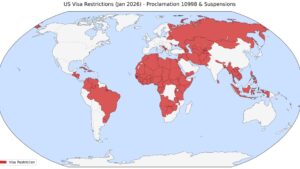
| Afghanistan | Bahamas |
| Albania | Bangladesh |
| Algeria | Barbados |
| Antigua and Barbuda | Belarus |
| Armenia | Belize |
| Azerbaijan | Bhutan |
| Bosnia and Herzegovina | Colombia |
| Brazil | Côte d’Ivoire |
| Myanmar | Cuba |
| Cambodia | Democratic Republic of the Congo |
| Cameroon | Dominica |
| Cape Verde | Egypt |
| Eritrea | Guatemala |
| Ethiopia | Guinea |
| Fiji | Haiti |
| The Gambia | Iran |
| Georgia | Iraq |
| Ghana | Jamaica |
| Grenada | Jordan |
| Kazakhstan | Liberia |
| Kosovo | Libya |
| Kuwait | North Macedonia |
| Kyrgyzstan | Moldova |
| Laos | Mongolia |
| Lebanon | Montenegro |
| Morocco | St Vincent and the Grenadines |
| Nepal | Senegal |
| Nicaragua | Sierra Leone |
| Nigeria | Somalia |
| Pakistan | South Sudan |
| Republic of the Congo | Sudan |
| Russia | Syria |
| Rwanda | Tanzania |
| St Kitts and Nevis | Thailand |
| St Lucia | Togo |
| Uruguay | Tunisia |
| Uzbekistan | Uganda |
| Yemen |
According to U.S. officials, the suspension is motivated primarily by concerns related to public benefits usage and immigration screening standards. The administration has argued that existing procedures do not sufficiently assess whether certain categories of immigrants may become dependent on government assistance after arriving in the United States.
The pause is intended to give federal agencies time to review and strengthen vetting procedures, reassess eligibility criteria, and align immigrant visa processing more closely with domestic economic and social policy priorities. Officials have emphasized that the policy is administrative rather than punitive, framing it as a temporary measure designed to improve oversight rather than permanently exclude specific nationalities.
Critics, however, argue that the decision disproportionately affects developing countries and undermines long-standing principles of family reunification and employment-based migration.
Once the policy takes effect, consular officers will be instructed not to issue immigrant visas to applicants who are nationals of the listed countries. This applies regardless of whether the application is family-based, employment-based, or diversity-based.
Processing timelines are expected to become uncertain. Some applicants may find their cases placed in administrative limbo, with no clear indication of when or if processing will resume. The U.S. government has not announced a fixed end date, describing the suspension as indefinite, pending the outcome of internal reviews.
There may be limited exceptions, particularly for individuals who hold dual nationality. In such cases, applicants may be able to proceed if they apply using a passport from a country not subject to the suspension, though this depends on individual circumstances and consular discretion.
According to current guidance, existing visas are not automatically canceled by the suspension. People who have already been issued an immigrant visa before the effective date should, still be able to travel to the United States.
However, entry into the country is always subject to inspection by U.S. Customs and Border Protection at the port of entry. While no blanket denial policy has been announced, travelers may face increased scrutiny.
For those with approved petitions but no issued visa, the situation is more complicated. Even if an application has been approved by U.S. Citizenship and Immigration Services, the final step, visa issuance by a consulate, may be delayed indefinitely if the applicant’s nationality is covered by the suspension.

Yes. Applicants with cases currently under review should expect delays and uncertainty. While applications can still be filed, many will not move forward to completion until the suspension is lifted.
Families waiting for reunification and employers sponsoring foreign workers for permanent roles may experience prolonged separation or staffing challenges. Immigration attorneys are advising affected individuals to monitor official updates closely and avoid making irreversible travel or relocation plans.
No. Unlike previous travel bans that restricted entry into the United States, this policy focuses on visa processing, not entry itself. Non-immigrant travel remains largely unaffected, and the policy does not prohibit people from the listed countries from entering the U.S. if they already hold valid visas.
That said, the practical effect for many families and workers is similar to a freeze on permanent immigration pathways.
While the current policy focuses on immigrant visa processing and does not constitute a travel ban, separate measures related to entry restrictions and travel bans took effect in January 2026. These policies follow a different legal framework and may affect travelers and visa holders in distinct ways.
For a detailed breakdown of the January 2026 U.S. travel ban, including affected countries, exemptions, and practical implications, please refer to our dedicated article below.
January 2026 U.S. Travel Ban – Full Overview
The suspension affects immigrant visas, which means its impact on E-2 and EB-5 visas differs significantly because these two programs fall into different legal categories.
The E-2 Treaty Investor visa is a non-immigrant visa. It allows foreign nationals from treaty countries to live and work in the United States while they actively manage a business in which they have made a substantial investment.
Because the E-2 is not an immigrant visa, it is not included in the suspension.
However, applicants should expect heightened scrutiny and potentially longer processing times, as consular officers may apply stricter financial and eligibility reviews during the broader policy shift.
At this time, the EB-5 Immigrant Investor Program has not been officially included in the announced suspension. While EB-5 is classified as an immigrant visa and leads to permanent residence (a green card), no formal guidance has been issued confirming that EB-5 processing is suspended for nationals of the affected countries.
However, given the broad scope of the announcement and the evolving nature of U.S. immigration policy, future clarifications or adjustments cannot be ruled out.
What this means in practice:
Given the uncertainty, professional legal advice is strongly recommended, and applicants should rely only on official guidance from U.S. authorities as further information becomes available.
While the suspension creates uncertainty for many applicants, it is important to note that not all immigration pathways are affected. In parallel to traditional immigrant visa routes, some of our programs remain fully operational and unaffected by these measures, offering eligible individuals continued access to global mobility and long-term planning options.
Programs such as Malta Citizenship by Merit, São Tomé and Príncipe Citizenship by Investment, Nauru Citizenship by Investment, Turkey Citizenship by Investment, and Vanuatu Citizenship by Investment continue to provide stable and internationally recognized frameworks.
Through these jurisdictions, qualified applicants may still pursue lawful immigration strategies, including eligibility to apply for U.S. immigrant visas under existing regulations, without being subject to the current suspension.